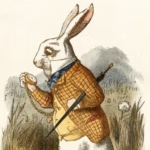
The spirit of the air these days calls us all to work as quickly as possible, while, of course, maintaining the quality of previous ages, which, us moderns forget, was done slowly. It was not the tobacco smoke staining the waxed linen that made their work excellent, though the aroma certainly was excellent. It was not the lead pencils or the ammonia which made their products leave a mark, though they certainly left their marks. It was the slowness of the work that made the previous ages esteemed. Their work – no, the idea of their work, is a real myth that moderns wish to see in their own lifetimes. But modernity, while desiring the old greatness, rejects the old prejudices which made them great in exchange for new prejudices.
Before some knee jerks itself upon reading my statement that old prejudices were great and strikes my own knee, which, is innocent, I will add some detail. There were old opinions that walked about the streets all of which never tried to prove themselves with data or studies. These sayings sounded like, slow and steady wins the race and another slow is smooth, smooth is fast. G.K. Chesterton once said, “One of the great disadvantages of hurry is that it takes such a long time.” These sayings never tried to prove their case. If asked where they heard such a claim, they’d point you to some old myth or fairytale. They said their spill and kept walking along. The modern prejudices say things like, “Men had always been in darkness and the superstitions of savages.” It is with their swift dismissal of all old wisdom that they forge ahead on their own. They dare not look back at the old things, those which are still true, because they are hard to do. It is easier to wave them away and go with the current fit of madness.
I’m afraid I confused some in my previous paragraph but I must trudge on. I return my thought now to the current air within the transportation industry and its celebrated virtue of juggling. Engineers are encouraged to juggle their tasks and the tasks of others, which, by some mutation, probably because their coworker isn’t as good of a juggler, have landed on their desk. To let one task sit would be an error. To leave the ninety-nine tasks and to focus on one is unimaginable. All tasks must be suspended in air at all costs. Well, except at the expense of quality, of course. Unfortunately, quality seems to have been misplaced. Perhaps the juggler dropped it somewhere.
I propose to go back to the old ways of working, which, looking at the calendar, wasn’t that long ago. I want to tackle a job with plenty of time to finish it in a great way. I want to stop context switching and frying my brain. If my career is to last for several more decades, I cannot set fire to myself every month. I will burn out. The old saying is true: what can’t last won’t. This reflection of mine, I think, is not limited to myself. I believe it is a larger issue; one too large for me to have a solution for everyone. But I do have an idea to fight against this sickness of the air. And that is to work slower. Perhaps I’ll slowly explain what I mean over time. Or perhaps, like Chesterton, I’ll speak my mind and move on.